Review: The Place on Dalhousie by Melina Marchetta

9780143793533.jpg

Reviewed by Simon McDonald

A deliciously engaging exploration of love, parenthood and belonging, The Place on Dalhousie charts familiar fictional territory, but Melina Marchetta’s inimitable artistry elevates the novel far beyond the sum of its parts into one of my favourite books of the year.

It opens in 2009, when Rosie meets Jim — “SES Jesus”, as Rosie thinks of him, because of his orange overalls and facial hair — in a town that’s about to be flooded by the Dawson River in Queensland. She’s been in town for five weeks now, caring for a cantankerous old lady named Joy Fricker, and recovering from the abrupt departure of her boyfriend, Luke. She’s not looking for a relationship, but partakes in what she assumes is casual sex, ignoring her burgeoning attraction to this stranger, not just to his body but his personality, his genuineness.

Two years later, Rosie has returned to her family home on Dalhousie in Sydney, that her father, Seb, was in the process of rebuilding, but never completed. In his place is Martha, who married Seb less than a year after the death of Rosie’s mother, and who Rosie can’t help but loathe. It is a house they both lay claim to; a place neither can let go of. But beyond their mutual enmity, both women have other issues plaguing their lives; Rosie is coping with the living, breathing consequence of her liaison with Jimmy (who is about to re-enter her life); and Martha is battling to come to terms with the total upheaval the death of Seb had upon her existence.

This is a book with so much heart, and traverses such a rich emotional landscape, with a deftness rarely displayed. Hard to put down, impossible to forget, The House on Dalhousie is one of those precious books you don’t want to end. I would’ve happily spent another 300 pages with Rosie, Jimmy, Martha, Ewan and co.

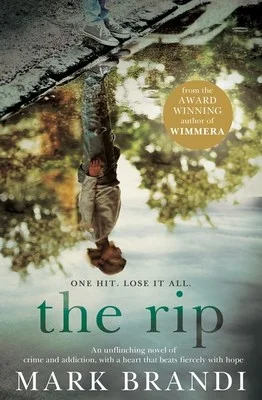
Review: The Rip by Mark Brandi

large_therip.jpg

Simon McDonald is convinced that under the hood of Mark Brandi’s novels thrums a noir engine.
Wimmera and The Rip —  both intoxicating, unsettling masterpieces — feature characters plummeting inexorably towards obliteration, induced perhaps by events outside their control, but perpetuated by their own actions. One bad choice begets another in the hopes to solve or rectify the first. It starts as a gradual slide, then progresses into a nosedive from which there is no return. To use Otto Penzler’s words: the protagonists of Wimmera and The Rip are “entangled in the web of their own doom.”

We’re attracted to such stories because its human nature to ruminate on the bad decisions people make, and avow to avoid walking that same path. We witness their mistakes so we don’t have to make them ourselves.

Or so we hope.

With sparse, yet beautiful prose, Mark Brandi portrays destitution and addiction with neither voyeurism or judgement; instead he paints a devastating portrait of two people (and a dog) running the long marathon of struggle and survival on the streets of Melbourne. But on the streets, interpersonal relationships are just as likely to open you up to salvation as damnation. Which is precisely the case when Anton — our narrator’s companion — welcomes Steve into their lives.

large_9780733640391.jpg

Sure, Steve’s got an apartment they can crash in, and he’s got access to drugs; but there’s something wrong with the guy. Prone to fits of violence, not to mention the strong smell — like vinegar, but stronger — wafting from behind his padlocked door. Staying in this apartment, with a temperamental stranger for a flatmate, and Anton forced back into a life of crime to maintain the creature comforts of their new home, is a gamble; if it doesn’t pay off, the consequences are catastrophic. But when the alternative is life back on the streets, maybe it’s worth it; maybe it’s acceptable to close your eyes to the incongruities of the apartment, and Steve’s violent tendencies, and just accept and enjoy the daily hit that briefly whitewashes reality. When you can’t afford your next meal, can you really afford to take the moral high ground?

This is a story of real life: of human frailties and violence. It is chilling and completely credible as it speeds towards a dark inevitability. It is an incredible step forward for a writer of commanding gifts, who seems poised on the threshold of even greater accomplishment.